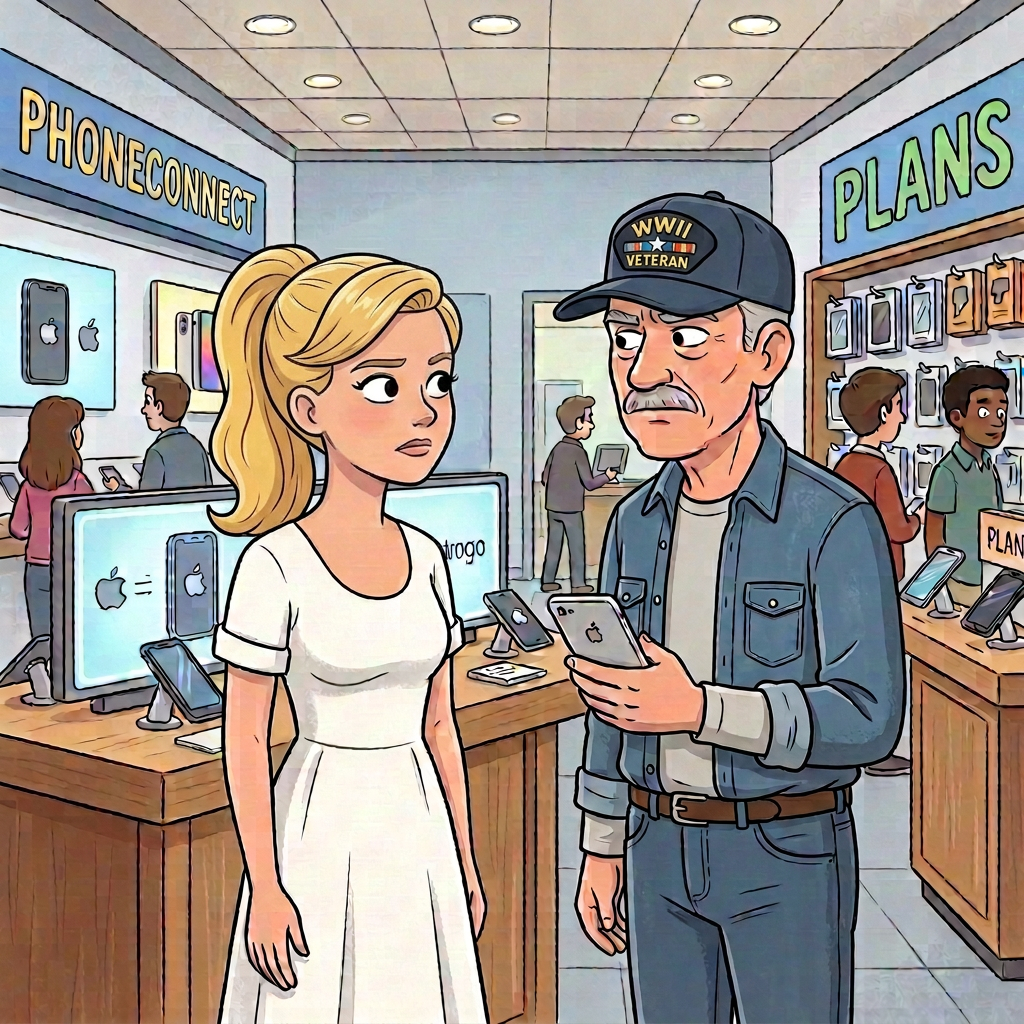
A few years ago, I was upgrading my “something‑something Samsung” to an iPhone. I assumed the hour I spent waiting would be wasted time — until I found myself standing next to an older gentleman doing the same thing.
We exchanged hellos. I noticed his stoop, his neatly ironed shirt, his perfectly combed silver hair. He looked like someone’s grandfather, the kind who still shines his shoes and folds his receipts. I wondered what brought a man in his eighties in for an iPhone when I can’t even convince my sixty‑year‑old father to use a flip phone.
And then I overheard him ask the young employee, “Do you know who Dr. Mengele was?”
Sadly, the young man did not. But I knew. I knew who the Doctor of Death was. Of course I knew.
The man caught my eye, reached into his wallet, and handed me an ID card. A POW card. His POW card. The swastika stamped beside the photo of a young American corporal — him — made my stomach drop.
He told me he was on his way to his regiment’s reunion. He said his battalion had liberated more captives from the camps than any other unit. He mentioned Dr. Mengele again. And then he told me about a woman he knew — Eva Kor — one of the surviving twins.
Just like that, our conversation ended. He took his new phone and walked out, leaving me standing there with the weight of history pressed against my chest.
Later, at home, I looked him up. I looked up Eva Kor. I looked up the children, the twins, the camps, the posters, the propaganda — all the things my mind wishes it didn’t know but absolutely must never forget.
And I thought: If I could erase one event from history, it would be the one that taught us how easily humanity can lose its humanity. The one that showed us what happens when cruelty becomes policy.
The one that still echoes in the minds of survivors, descendants, and anyone who has ever struggled with the darkness people are capable of.
But I can’t erase it. None of us can.
What we can do is remember. We can stay awake to the truth that hell has existed here on Earth — and that the only way to prevent it from happening again is to refuse to look away.
So, the next time you’re in an Apple Store, or a grocery line, or anywhere ordinary, remember: the people standing next to you may carry stories that changed the world. And some of those stories are the reason we must never erase the past, even when we wish we could.

Image is a poster from a Nazi campaign during WW II. The translated caption, “60,000 Reichmarks is what this person suffering from a hereditary disease costs the People’s community during his lifetime. Comrade, that is your money too.”
On September 1, 1938. Adolf Hitler signed an order to begin the systematic euthanasia of mentally ill and disabled people and had those posters strung throughout Germany.
If this spoke to you, be sure to “like” and share it over social with someone who’d appreciate the flavor …
DISCLAIMER: These are my personal experiences and opinions. Nothing here is medical, nutritional, or therapeutic advice. Also, I’m a writer and an editor. And I try my best to make sure every post is articulate and free from errors. However, being that I edit my own work—and it’s next to impossible to properly edit your own work—I admit, occasionally there may be an error or two I miss. But doing so doesn’t make me an idiot so don’t be mean. Just smile, pat yourself on the back for finding an error and be glad you’re not the only one who makes mistakes sometimes … xoxox


Leave a Reply